
What If You're Not Satisfied With Your NHS Scan Report?
Receiving a scan report that leaves you confused, uneasy or simply unconvinced is more common than most people imagine - and being dissatisfied does not make you difficult or ungrateful. You have clear rights and several practical options. This guide explains what to do, step by step. The key is knowing whether your concern is about the accuracy of your report or the quality of your care - because each has a different solution.
Doctorum Radiologists
Published June 2026
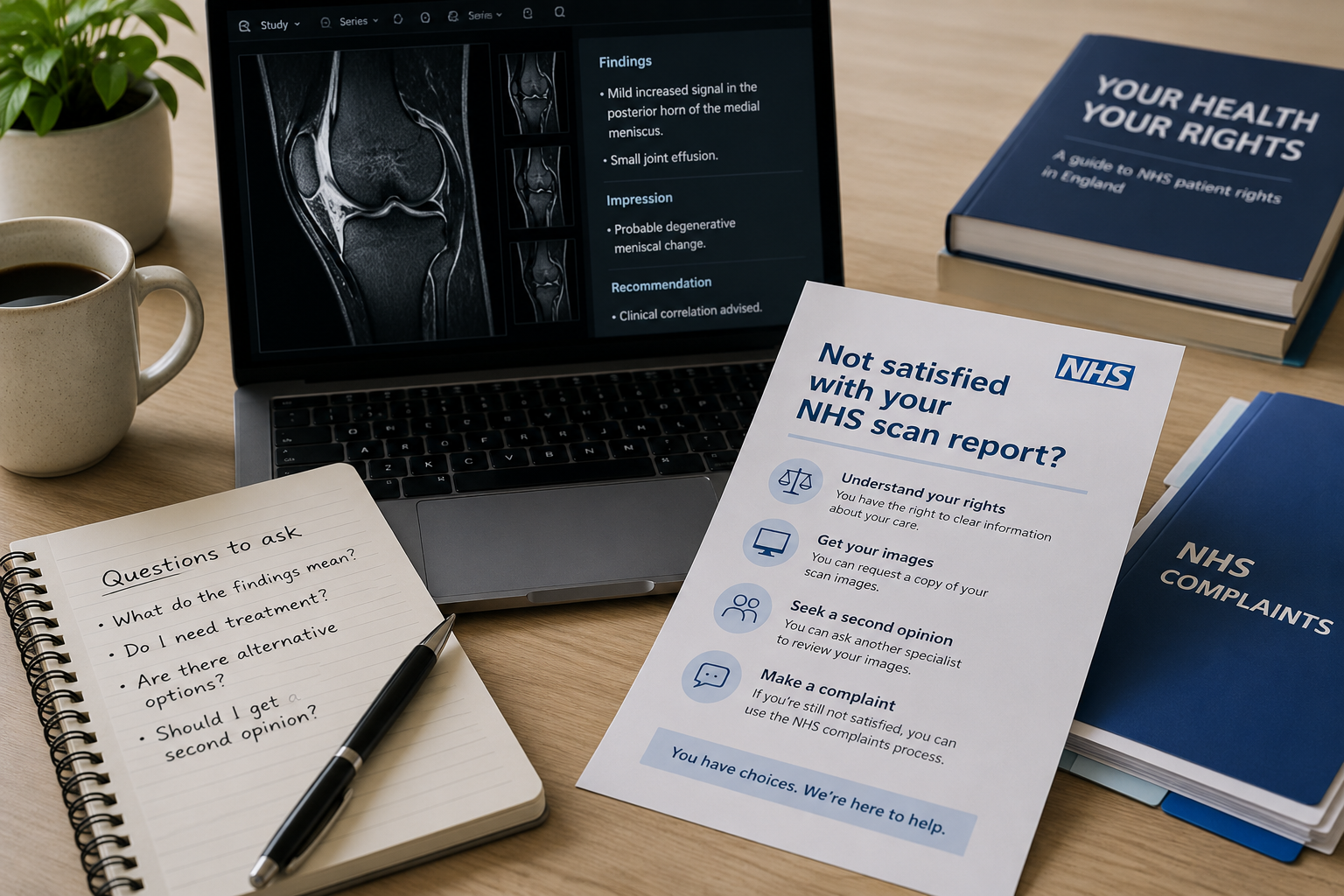
A radiology report is written for the doctor who ordered your scan, not for you. It is technical, concise and frequently hedged with cautious language. So it is entirely understandable that many patients come away feeling underwhelmed, unsettled or unsure what the report actually means for them - particularly when the report says everything is "normal" but their symptoms have not gone away, or when it raises a finding without explaining what happens next.
The right next step depends on why you are dissatisfied. Broadly, there are four different situations, and each has its own route forward.
First, Work Out Which Kind of "Not Satisfied" This Is
"I don't understand it." - The report is full of jargon and you are not sure what it means. Start with the clinician who ordered the scan.
"It says normal, but I'm still unwell." - The report does not match your experience. Consider whether a different scan or an independent review is warranted.
"I'm not sure the report is right." - You have doubts about the accuracy of the interpretation. This is a clinical question - ask for a second opinion.
"I'm unhappy with how I was treated." - The delay, the communication or the service fell short. This is a complaint - use the formal NHS complaints process.
Keeping these apart matters, because a formal complaint will not re-read your scan, and a second opinion will not resolve a grievance about waiting times. Below we cover each route, and the rights that sit behind them.
29%
UK shortfall of consultant radiologists in 2024 - projected to reach 39% by 2029 (RCR)
256,777
written complaints made about NHS services in England in 2024-25 - a record high (NHS England)
12 months
the time limit to raise a formal NHS complaint from the incident, or from becoming aware of it
A little context helps explain why dissatisfaction is so common. The Royal College of Radiologists' workforce census found the UK is short of around 29% of the consultant radiologists it needs - almost 2,000 doctors - a gap projected to widen to 39% by 2029 if nothing changes. Demand for CT and MRI grew by roughly 8% in a single year, far outpacing the growth in the radiologist workforce, and nearly two-thirds of imaging service leads reported that they did not have enough radiologists to deliver safe and effective care. The College's 2025 census reported that the NHS had spent around £1.4 billion over five years on short-term measures - locums, outsourcing and overtime - to keep up with reporting. Reports are increasingly produced under time pressure, out of hours, or outsourced - all of which make the case for knowing your options.
Step 1 - Go Back to the Doctor Who Ordered the Scan
Your GP or referring consultant is the person who requested the scan, and it is their job to interpret the radiologist's report in the context of you - your symptoms, your history and your examination. A finding that reads alarmingly in isolation may be routine in context; a "normal" report may still warrant further action if your symptoms persist.
Book an appointment specifically to discuss the result, and go in with written questions. Useful ones include: What does this finding actually mean for me? Does it explain my symptoms? If the scan is normal, what else could be causing them? Is a different type of scan appropriate? What is the plan if my symptoms continue? For many patients, this single conversation resolves the dissatisfaction entirely.
Step 2 - Get a Copy of Your Report and Your Images
Whatever you decide to do next, you are far better placed if you hold your own records. Under the Data Protection Act 2018 and UK GDPR, you have the right to a copy of your health records - including both the written radiology report and the scan images themselves - usually free of charge and provided within one month of your request.
The images matter just as much as the report. A second opinion is only meaningful if another radiologist can examine the original pictures (the DICOM files), not merely re-read someone else's written conclusion. You do not need your GP's permission to request your own images, and there is no need to give a reason.
We cover exactly how to do this - who to contact, what to ask for, and the wording to use - in our step-by-step guide: How to Request Your NHS Scan Images.
Step 3 - Ask for a Second Opinion
If your concern is about the report itself - its accuracy, its completeness, or the uncertainty in its language - then the appropriate response is a second opinion, not a complaint. As the NHS itself puts it: "Although you do not have a legal right to a second opinion, a healthcare professional will rarely refuse to refer you for one."
Within the NHS, you would usually ask the clinician who ordered the scan, or go back to your GP to request a referral. Given the workforce pressures described above, however, an NHS second opinion can take time to arrange. This is where an independent private review is often quicker: with a copy of your images, a consultant radiologist can provide a fresh, formal written report - typically within 24 to 48 hours - without the need for a GP referral.
A second opinion is not a sign of distrust, and it does not imply the first report was negligent. The published evidence shows that genuine differences in interpretation between radiologists are not rare - particularly when a study is re-read by a subspecialist with direct expertise in that body area. We examine the data in detail in our companion article on when to get a second opinion on a scan.
"Wanting your scan looked at again is not awkward or ungrateful - it is exactly what an experienced doctor would do with their own family's imaging. The key is matching the right action to the right concern."
Doctorum Consultant Radiologist
Step 4 - If Your Concern Is About the Care: the Formal Complaint Route
If your dissatisfaction is about how you were treated - a long delay, poor communication, a report that went astray, or the way news was broken to you - that is a matter for the NHS complaints process. In 2024-25 there were 256,777 written complaints about NHS services in England - a record high - so this is a well-trodden and entirely legitimate path.
There are a few key points to understand:
Start with PALS, or raise it informally first
In England, every NHS trust has a Patient Advice and Liaison Service (PALS). PALS is not part of the formal complaints procedure, but it can often resolve concerns quickly and explain your options. Many issues are settled at this stage without a formal complaint.
Complain to the provider or the commissioner - not both
You can complain directly to the service provider (the hospital or GP practice), or to the commissioner that pays for the service - for most NHS care in England, that is your local integrated care board (ICB). You should choose one route, not both.
Mind the 12-month time limit
A complaint should normally be made within 12 months of the incident, or of the point at which you became aware of it. The organisation can use discretion to accept a later complaint where there are good reasons. Free, independent NHS complaints advocacy is available to help you put your complaint together.
If you are still unhappy: the Ombudsman
If the response does not resolve your complaint, you can ask the Parliamentary and Health Service Ombudsman (PHSO) to review your case. You normally need to bring your complaint to the Ombudsman within a year of becoming aware of the problem.
One important caveat: the complaints process examines whether you were treated properly - it does not produce a fresh interpretation of your scan. If you believe the report may actually be wrong, a clinical second opinion (Step 3) is the tool for that, and the two can be pursued in parallel.
When You Think the Report May Be Wrong
This deserves singling out, because it is the concern patients most often hesitate to voice. If something does not add up - the report does not fit your symptoms, an earlier scan was read differently, or a finding you expected to be mentioned is absent - it is reasonable to have the images formally re-examined by an independent consultant.
Acting promptly is worthwhile. A discrepancy discovered before a treatment decision is made is far more useful than one found afterwards. If a major procedure, course of treatment or staging decision is being planned on the basis of your scan, an independent review beforehand is a recognised part of careful medical practice - not an obstacle to it.
At a Glance: Which Route Should You Take?
| If you... | Best first step |
|---|---|
| don't understand the report | Discuss it with your GP or referring doctor |
| have a "normal" report but ongoing symptoms | Ask whether a different scan or a review is needed |
| doubt the accuracy of the report | Get your images and arrange a second opinion |
| are unhappy with the service or delay | Use PALS / the formal NHS complaints process |
| face a major treatment decision from a scan | Have the imaging independently reviewed first |
Want your NHS scan reviewed independently? Doctorum can help.
Our UK GMC-registered consultant radiologists provide independent second opinions on MRI, CT, ultrasound, mammography, X-ray and PET CT studies. With a copy of your images, reports are delivered within 24-48 hours at a fixed price of £200, with no GP referral required. If you are unsure whether a second opinion is the right step, we are happy to talk it through first.
Find out about our second opinion serviceThis article is general information about your options and rights, not medical or legal advice. Complaints procedures differ slightly across England, Scotland, Wales and Northern Ireland; check your nation's NHS guidance for the exact process. If you have an urgent or serious health concern, contact your GP, NHS 111, or emergency services.
Sources
- NHS (nhs.uk) - Feedback and complaints about NHS services / How to complain to the NHS. nhs.uk/contact-us/how-to-complain-to-the-nhs/
- NHS (nhs.uk) - Getting a second opinion.
- Parliamentary and Health Service Ombudsman (PHSO) - Making a complaint and time limits. ombudsman.org.uk
- Information Commissioner's Office (ICO) - Your right of access (Data Protection Act 2018 / UK GDPR). ico.org.uk
- The Royal College of Radiologists (2024 & 2025) - Clinical Radiology Workforce Census (29% shortfall, projected 39% by 2029; ~£1.4bn spent over five years on short-term staffing fixes). rcr.ac.uk
- NHS England Digital (2025) - Data on Written Complaints in the NHS, 2024-25 (256,777 total complaints - a record high).
Related Articles
When Should You Get a Second Opinion on a Scan?
What the published evidence shows about how often radiologists disagree - and when an independent review is worth seeking.
Patient GuidesHow to Request Your NHS Scan Images
You have a legal right to a copy of your scan images, free of charge. Here is exactly how to request them.