
Why a Truly Independent Second Opinion Matters - What the Research Shows
A second opinion is only as valuable as it is independent. Recent research shows that when a radiologist can see an earlier opinion, they are more likely to follow it - even when it is wrong. We look at what the evidence says, why independence and specialist expertise both matter, and what to look for when you seek a review of your scan.
Doctorum Radiologists
Published October 2026
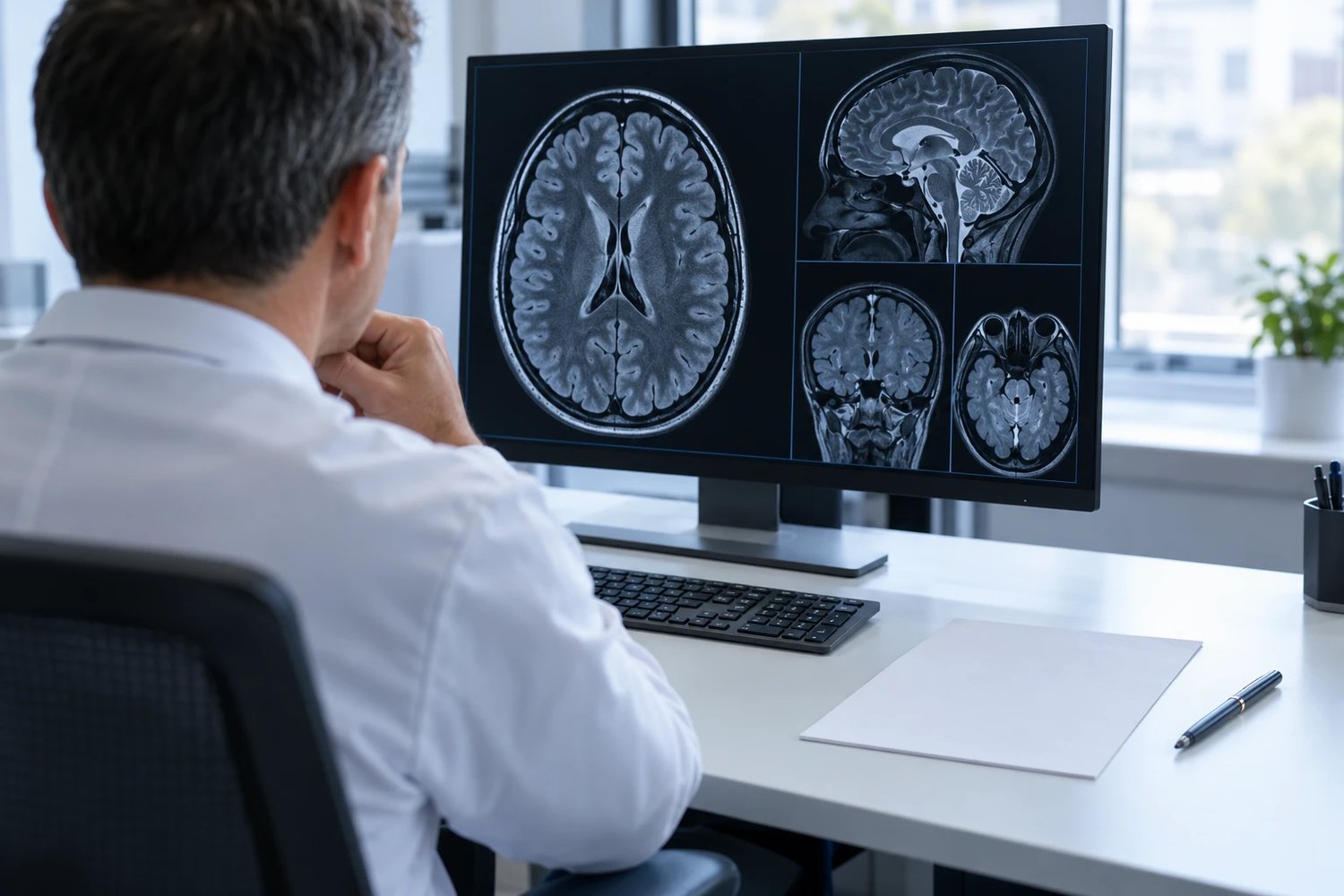
Most people assume that a second opinion is simply a second look. In practice, how that second look happens makes a real difference. A radiologist who starts by reading the first report, or who already knows what a colleague concluded, is not looking at your scan with completely fresh eyes - and the research shows this can change what they see.
This article is not a criticism of the radiologists who report scans every day, in the NHS or elsewhere. Most reports are accurate, and a difference of opinion does not mean the first report was negligent. But if you are going to the trouble of seeking a second opinion, it is worth understanding what makes one genuinely independent.
Reading a Scan Is an Expert Judgement
A radiology report is not a printout from a machine. A 2024 review of errors in radiology describes radiological interpretations as "best understood as expert opinions formed through the evaluation of available evidence". Like any expert judgement, two experienced specialists can look at the same images and reach different conclusions, particularly in complex cases.
That is not a reason for alarm. A 2022 review in the Journal of Medical Imaging and Radiation Oncology notes that while errors in diagnostic radiology are not infrequent, patient harm is less common - because the medical system has safeguards such as multidisciplinary meetings, subspecialty expertise and second opinions. A second opinion is one of those safeguards. The question is how to make it work as well as possible.
The Hidden Problem: A First Opinion Can Steer the Second
Radiologists have a name for one of the most important pitfalls in this area: alliterative error, also called "satisfaction of report". It describes the tendency to follow the conclusion of an earlier report. As the 2024 review puts it, if a first radiologist made a wrong assessment, a second radiologist will be more prone to making the same mistake. Its recommended remedy is simple: read old reports only after independently evaluating the images and drawing your own conclusions.
This is not just theory. Three studies show the effect directly:
NHS breast screening (2022)
In the NHS Breast Screening Programme, two readers examine each set of mammograms. A UK study using data from the CO-OPS trial found that when the second reader could see the first reader's decision, they were more likely to agree with it and less likely to make an independent judgement. The authors described this as alliterative bias, and concluded that it negates some of the benefits of double reading.
A controlled experiment with practising radiologists (2022)
Researchers gave 27 practising radiologists a number they were told was a previous radiologist's estimate of the chance that a mammogram showed cancer - in fact, the number was random. The radiologists' own judgements followed the random number and ignored the evidence in the images. Without that "previous opinion", the same radiologists detected the cancers in the same mammograms highly accurately.
Nearly 90,000 screening mammograms (2015)
The largest study to compare the two approaches head-to-head is older, but remains the key reference. In a Dutch screening programme covering 87,487 screening mammograms, second readers who could not see the first reader's decision found more of the cancers - a programme sensitivity of 83% compared with 76% - although more women were called back for further tests.
83% vs 76%
of cancers found when the second reader could not see the first reader's decision, compared with when they could
21.4%
of scans referred to a UK specialist neuroradiology second opinion service had a major, management-changing discrepancy (2026)
29%
shortfall in the UK radiologist workforce - almost 2,000 radiologists (Royal College of Radiologists, 2026)
Independence does not mean ignoring useful information. Comparing a new scan with previous images can improve accuracy, and a 2021 systematic review found that clinical information has a positive impact on the radiology report. The point is the order: the most independent second opinion starts with the images themselves, and forms its own view before being influenced by someone else's conclusion.
Specialist Expertise Is the Other Half
Independence on its own is not enough. A fresh pair of eyes adds the most when those eyes belong to a radiologist who specialises in the relevant part of the body.
A 2026 UK study published in Clinical Radiology reviewed 580 consecutive scans sent for a formal second opinion at a tertiary neuroscience centre. Specialist neuroradiologists disagreed with the original report in 42.2% of cases, and in 21.4% the difference was major. Almost all of those major discrepancies changed the diagnosis (99.2%), and most changed the treatment (93.5%). The most common type of error was faulty reasoning - an interpretation problem rather than something simply being missed.
The picture is similar in musculoskeletal imaging. A 2025 systematic review of eight studies, covering 11,186 scans re-read by specialist musculoskeletal radiologists, found clinically significant discrepancies in between 1.4% and 27.9% of cases, with the highest rates in bone and soft tissue tumour imaging.
To keep this in proportion: these figures come from scans that were referred for a second opinion, often because there was already doubt, so they are much higher than the error rate in everyday reporting. And not every scan needs a subspecialist. A large study of nearly 5.9 million acute scans from US community hospitals found that discrepancy rates were no higher when radiologists reported outside their own specialist area. The case for a subspecialist review is strongest where the question is complex - such as cancer imaging, neuroradiology, or a finding that does not fit the symptoms. For more on this, see our article on when to get a second opinion on a scan.
Why This Matters More Now
UK radiologists are working under considerable pressure. The Royal College of Radiologists reported in May 2026 that the UK is short of almost 2,000 radiologists - a 29% shortfall - and that 940,900 scans in England waited more than a month to be reported in 2025.
Recent reviews of human factors in radiology, including a 2025 UK review in the European Journal of Radiology, highlight how distractions, interruptions, fatigue and cognitive biases can all affect the accuracy of image interpretation. None of this reflects on the skill or dedication of individual radiologists. It simply means that an unhurried, independent review by a specialist can add real value when a result is important to you or does not seem to fit.
What a Truly Independent Second Opinion Looks Like
Based on the evidence above, these are the questions worth asking about any second opinion on a scan:
- Will an expert radiologist review your actual images? A truly independent second opinion means a specialist radiologist examines the images themselves and writes their own, independent report - rather than commenting on the original one.
- Does the radiologist form their own view first? The research suggests the most independent opinion is formed from the images, not by starting from the original report.
- Did they have any part in the original report? A genuinely fresh look comes from someone who was not involved the first time.
- Do they specialise in the right area? A brain MRI reviewed by a neuroradiologist, a knee MRI by a musculoskeletal radiologist, and so on.
- Is there any financial interest in the outcome? The reviewer should have nothing to gain from finding - or not finding - a problem, such as a link to treatment that might follow.
- Is a named consultant accountable for the report? You should know who reviewed your scan, and be able to check their GMC registration.
Your Right to a Second Opinion in the UK
The General Medical Council's Good medical practice states that doctors must respect a patient's right to seek a second opinion. Within the NHS, however, there is no legal right to a second opinion: you can ask your GP or hospital doctor to refer you, and requests are rarely refused, but you cannot usually choose who provides it.
You can also arrange an independent second opinion privately. For a scan, this means obtaining a copy of your images and asking a consultant radiologist to review them. If you are not sure how to get your images, our guide on how to request your NHS scan images explains the process.
A Balanced View
Most scans are reported accurately, and most second opinions confirm the original findings. When a second opinion does differ, that is not proof that the first radiologist was careless - interpretation involves judgement, and some differences reflect genuine uncertainty. What the evidence does show is that when a second look is needed, it is most valuable when it is genuinely independent and carried out by the right specialist.
How Doctorum approaches second opinions
Our consultant radiologists review the original images and form their opinion from the images themselves, rather than starting from the original report. Each case is matched to a consultant with subspecialty expertise in the relevant area, and every report carries the name and GMC registration number of the consultant who wrote it. Doctorum has no financial link to any treatment that follows, so we have nothing to gain from finding - or not finding - a problem.
Find out about our second opinion serviceSources
- Pesapane et al., Journal of Clinical Medicine (2024) - Errors in Radiology: A Standard Review
- Tee et al., Journal of Medical Imaging and Radiation Oncology (2022) - Error and cognitive bias in diagnostic radiology
- Cooper et al., European Radiology (2022) - Optimising breast cancer screening reading: blinding the second reader to the first reader's decisions
- Branch et al., Diagnostics (2022) - Biasing Influence of 'Mental Shortcuts' on Diagnostic Decision-Making: Radiologists Can Overlook Breast Cancer in Mammograms When Prior Diagnostic Information Is Available
- Klompenhouwer et al., European Journal of Cancer (2015) - Blinded double reading yields a higher programme sensitivity than non-blinded double reading at digital screening mammography
- Castillo et al., Journal of Medical Radiation Sciences (2021) - The effect of clinical information on radiology reporting: A systematic review
- Abdelsalam et al., Clinical Radiology (2026) - A formal neuroradiology second opinion service changes management in one in five cases
- Patel and Isaac, European Journal of Radiology (2025) - The clinical value of second-opinion reporting by subspecialist musculoskeletal radiologists
- Chong et al., American Journal of Roentgenology (2022) - Interpretations of Examinations Outside of Radiologists' Fellowship Training: Assessment of Discrepancy Rates Among 5.9 Million Examinations
- Cowen et al., European Journal of Radiology (2025) - Human factors in diagnostic radiology: practical challenges and cognitive biases
- Royal College of Radiologists (2026) - NHS spent record £1.4bn on short-term fixes to radiologist shortage in past 5 years
- AuntMinnie Europe (2026) - NHS spent £1.4B on radiologist shortage fixes in 5 years
- General Medical Council (2024) - Good medical practice - Domain 2: Patients, partnership and communication (paragraph 18)
- NHS 111 Wales - Second opinion
- NHS Bristol, North Somerset and South Gloucestershire ICB - Second opinions
Want an independent second opinion on your scan?
Formal written reports from UK subspecialist consultant radiologists within 24-48 hours. Fixed price. No GP referral required.
Related Articles
When Should You Get a Second Opinion on a Scan?
We explain when an independent specialist review provides clarity, reassurance or meaningfully better outcomes.
Second OpinionsWhat If You're Not Satisfied With Your NHS Scan Report?
The steps to take, from talking to your doctor to getting a copy of your images and asking for a second opinion.